

Creating a Pet Memorial That Feels Like Your Companion
Losing a companion who greeted you at the door every evening leaves a quiet kind of ache. You may want to do something, anything, that shows how much they mattered, but not know where to begin. That's completely normal. A good pet memorial doesn't have to be elaborate or perfect. It just needs to feel like them. In this guide, we'll walk through a gentle, step-by-step way to build a pet memorial around who your companion really was, one small decision at a time. There's no rush, and you don't have to do it all at once.
Table of Contents
- Quick Takeaways
- Start With Who They Were
- Choosing a Memorial Style That Fits Your Companion
- Comparing Memorial Approaches
- Building a Memory Box
- Writing a Tribute That Sounds Like Them
- Involving Family and Children
- Keepsakes That Hold Up Over Time
- Living Tributes and Anniversaries
- Frequently Asked Questions
- References
Quick Takeaways
| Key Insight | Explanation |
|---|---|
| Start with memories, not products | Write down five to ten specific moments before you choose anything. The small details will point you toward the right memorial. |
| Match the tribute to their personality | A shy cat and a bouncy retriever need different kinds of remembrance. Let their habits guide the style. |
| Gather belongings while they still feel like home | Collars, favorite toys, and photos are easiest to collect in the weeks after loss, before they are tucked away. |
| Write the tribute in your own voice | A few honest sentences about their favorite spot in the house will mean more than a polished paragraph that sounds like everyone else. |
| Give family members a small role | Children and relatives often grieve differently. A simple task, like picking a photo, helps them feel included. |
| Check every name, date, and engraving | Proofread carefully before ordering, and ask for a proof whenever the option is offered. Small typos are hard to live with. |
| Plan one day a year to return to | An anniversary or birthday gives your memorial a steady rhythm, so remembering doesn't depend on a hard day. |
Start With Who They Were
Before you think about engraving, fabric, or frames, it helps to sit with the question of who your companion was. Maybe they were the dog who waited by the window at four every afternoon, or the cat who insisted on the one warm spot of your laptop. Those everyday habits are where a memorial that feels real begins.
In practice, grab a notebook and write down five to ten specific moments. Skip the big milestones for now and focus on ordinary things: the squeaky toy they carried everywhere, the way they tilted their head at a certain word, the route you walked every morning. These small pictures are more useful than any catalog when it's time to decide.
Writing down their daily rhythms
Think about the routines that shaped your home. Mealtimes, favorite spots on the couch, and the jingle of tags down the hallway all count. These details give you a practical map, because they show what your companion truly loved.
Pro tip: Keep the notebook somewhere you'll see it again. Many people add a line or two over the following weeks, and those later memories often find their way into the final tribute.
Gathering the small details
Ask family members and friends to share their own stories. A neighbor might remember how your dog greeted the mail carrier every single day, and that story can become part of a plaque or a written tribute. You don't have to decide anything yet. Gathering comes first, and it's a gentle way to keep your companion close while you're still grieving.
Choosing a Memorial Style That Fits Your Companion
Some pets were quiet homebodies who loved a sunny windowsill. Others were the life of every room, chasing toys and greeting visitors at the door. The right memorial often mirrors that energy, so the tribute feels like a continuation of who they were rather than a stranger's idea of grief.
Think about where your companion spent most of their time. If they lived on your bed, a soft blanket might feel right. If they rode along on every errand, a small keepsake you can carry or place in the car may suit them better. Neither choice is wrong, and both can hold a lot of love.
Keepsakes you can hold
Many people find comfort in something small and close at hand. A pendant or ring with a paw print, a ceramic mug with their name, or a pillow with a favorite photo can sit in the middle of daily life. You will reach for these objects without planning to, and that is part of their gift.
Pieces you can display or wear
Some families prefer a visible centerpiece, such as a framed portrait or a shelf with a few of their favorite things. A memorial you can see every morning often helps grief settle into something gentler over time, and it gives visitors an easy way to ask about your companion.
Comparing Memorial Approaches
There isn't one correct way to honor a pet. Most people end up combining two or three approaches. Comparing them side by side can make the decision feel lighter, especially when you're tired or unsure of your next step.
| Approach | Best For | Things to Consider |
|---|---|---|
| Memory box | Pets with favorite objects, like a toy, collar, or blanket they slept on | Keep items dry and clean. Store fragile things separately so they don't break in a closet. |
| Written tribute | People who think best in words, or families who enjoy sharing stories | Write it in short sections, and read it aloud before you finalize. It's easier to edit when you hear it. |
| Living tribute, such as a tree or garden | Households that want a place to visit and watch something grow | Choose a spot you'll see often. Make sure the plant suits your climate and yard. |
Every approach asks something different of you. A memory box asks for careful handling, a written tribute asks for honest reflection, and a living tribute asks for patience. If one of those feels too heavy right now, you can start with the one that feels easiest and come back to the others later.
Reading the trade-offs honestly
A memory box can be emotionally intense to open, while a garden takes months before it looks like much. Be honest about what you can handle this season. There's no prize for doing the hardest option first.
Mixing approaches in one memorial
Many people pair a small keepsake with a written tribute, or put a memory box next to a framed photo. Combining two approaches often feels more complete than relying on one, because each piece covers a different need: comfort, memory, and connection.
Building a Memory Box
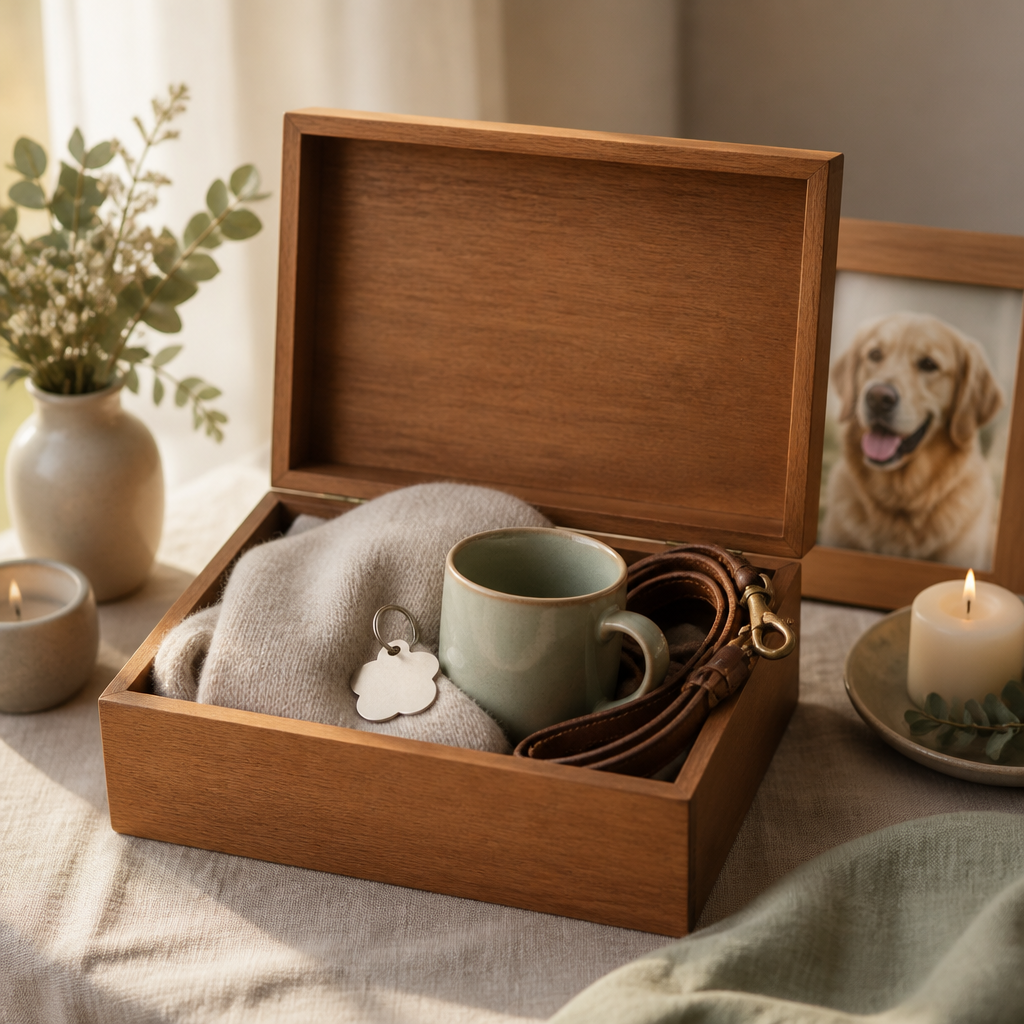
A memory box is one of the most tender ways to gather what remains of your companion's daily life. It works best when you fill it slowly. Rushing through the process can leave you feeling overwhelmed, and nothing about this needs to be fast.

Choose a box that feels calm and sturdy, with enough room for a few favorite objects and a small card. Lay everything out on a table first. Seeing the pieces together helps you notice which ones carry the most meaning and which ones you can let go of.
What to put inside
Many families include a collar, a favorite toy, a few photographs, and a note with the date they came home. Some add a lock of fur, which many people find comforting to keep. Keep the list personal. A single tennis ball can mean more than a full set of mementos if it was the only thing your dog would fetch.
Pro tip: Take a few photos of the memory box before you close it. Many people find that the pictures become easier to look at than the originals during the first few months.
Handling fragile and sensitive items
Wrap delicate pieces in acid-free tissue or a soft cloth, and store the box somewhere dry and away from direct sunlight. Avoid plastic bags for anything that might hold moisture. If you're unsure about a particular item, ask a museum conservator or a trusted local shop for basic storage advice.
Writing a Tribute That Sounds Like Them
Many people freeze when they sit down to write about a pet. You may feel that the words should be grand, or that you have to capture everything in a few lines. You don't. A tribute that sounds like you, and like them, is usually the one that feels most true.
Some people write a short obituary in the style of a local newspaper notice, listing their pet's favorite foods, their daily walk, and the people they loved. Others prefer a letter addressed directly to their companion. Both formats work well, and you can choose whichever feels more natural to you.
Starting with one true sentence
Begin with a single sentence that is honest and specific. Something like, "He always waited by the back door at dinnertime, even after we moved to a new house," tells a reader far more than a general line about loyalty. Once that first sentence is down, the rest tends to follow more easily.
Reading it aloud before you finalize
Read your tribute out loud, slowly, to yourself or a trusted friend. You'll notice where a sentence feels stiff or where a memory is missing. Edit gently, and keep the parts that make you smile, even if they make you cry a little too.
Involving Family and Children
When a pet dies, the whole household feels it, and each person grieves in their own way. A child may ask questions every day, while a partner may not say much at all. Giving everyone a small, meaningful role can help the household stay connected during a hard season.
It also helps to remember that no one has to share the same feelings at the same time. Some people want to talk about their companion every evening, and others need quiet. Offering both options, without pressure, makes the memorial feel like a place where everyone is welcome.
Giving children a meaningful job
Children often feel better when they have a task. They might draw a picture for the memory box, choose a photo for a frame, or pick the spot where the garden will go. These small jobs give them a way to help, and they often ask thoughtful questions while they work.
When family members grieve differently
One person may want a big ceremony, while another wants to skip it entirely. Try to find a middle path, such as a short moment together at dinner, and let each person keep the memorial in their own way. Honoring those differences is part of honoring your companion.
Keepsakes That Hold Up Over Time
Keepsakes are meant to be touched, looked at, and lived with for years. That's why it matters to think about materials, wording, and how the piece will feel in your hands on a difficult day. A little care at this stage can save you disappointment later.

Personalized items, such as blankets, pillows, and ceramic mugs, can carry a photo, a name, or a short phrase. Many people choose these because they can be used every day, which keeps the memory close without making it feel like a shrine. Think about how often you'd want to see or touch the piece.
Choosing materials that feel like comfort
Choose fabrics and finishes that feel good against your skin. If your companion loved to nap on something soft, a blanket in a similar texture may feel especially right. For objects that sit on a shelf, pick something sturdy enough to handle dusting and occasional bumps.
Checking engraving and wording before you order
Spelling matters. Double-check your companion's name, the dates, and any short phrase before you approve the order. Where a proof is offered, take the time to look at it in good light. A quick review now is far easier than dealing with a mistake later.
Living Tributes and Anniversaries
Some people want a memorial that grows, changes with the seasons, and invites them outside. A living tribute can be a tree, a flower bed, or a container garden on a balcony. It gives you something to tend, and that routine can be a quiet source of comfort.
Living tributes also work well alongside a yearly remembrance. Choosing one day each year to visit the plant, look at photos, or share a story gives your memorial a steady rhythm. It becomes a date you can prepare for, rather than a surprise.
Planting something that grows with you
Before you plant, check what suits your climate, your yard, and how much sun the spot gets. A small shrub, a perennial, or a flowering plant in a pot can be easier to care for than a large tree. Many families pick a plant that blooms at a certain time, so they can look forward to it each year.
Setting a yearly day to remember
Pick a date that already has meaning, such as the day they came home, their birthday, or the first day of spring they loved. Make it simple. Light a candle, share one story at dinner, or look through the photo album together. Small rituals repeated each year often hold more comfort than one big event.
Frequently Asked Questions
How soon should I start creating a pet memorial?
There's no fixed timeline, and you don't need to start right away. Some people begin the same week, while others wait months. If you feel pressure to act quickly, pause and remind yourself that the memorial can grow over time.
What if I can't decide on one memorial style?
Start with the option that feels most comfortable, even if it's small. A single keepsake or a short written tribute is enough to begin. You can add more pieces later, and many families build their memorial slowly over several seasons.
Is it okay to make a memorial if my pet was not a dog or cat?
Absolutely. Rabbits, birds, horses, and other companions can be honored in the same thoughtful ways. Focus on their particular habits, like a favorite perch, a hay routine, or the sound of their song, and let those details guide your choices.
What is a good first step if I feel stuck?
Write down three things your companion did every day, and choose one to honor first. That single detail can point you toward a keepsake, a sentence for a tribute, or a spot for a living memorial. Small steps add up, and you don't have to see the whole picture yet.
How can I keep the memorial from feeling too sad?
Include joyful memories alongside the hard ones. Choose photos where your companion looked happy, and tell funny stories when you gather. A memorial can hold both sorrow and warmth, and many people find that the warmth grows stronger with time.
We'd love to hear how you're honoring your companion, so please share your experience or any tips that helped you along the way.
References
- Eight creative and loving ways to honor a pet's memory from NPR
- Heartfelt creative pet memorial ideas from a mobile veterinary practice
- A guide to well-reviewed pet loss and memorial gifts