

Pet Memorial Ideas: 10 Heartfelt Tributes That Last
Losing a pet carves a hole that surprises even people who expected it. You reach for the leash out of habit, or you catch yourself pouring an extra bowl of food, and then the silence hits all over again. Finding meaningful pet memorial ideas is not about rushing grief. It is about giving that love somewhere to live after the animal is gone. The ten ideas in this guide are practical, lasting, and rooted in what actually helps grieving pet owners move forward, not just survive the immediate loss. Every suggestion below can be made deeply personal, which is the only thing that truly matters.
Table of Contents
- Quick Takeaways
- Why a Physical Memorial Matters
- Idea 1: Personalized Memorial Jewelry
- Idea 2: Custom Portrait or Artwork
- Idea 3: A Memorial Blanket or Pillow
- Idea 4: Plant a Memorial Tree or Garden
- Idea 5: A Memory Box or Keepsake Collection
- Idea 6: Personalized Ceramic Mug or Everyday Keepsake
- Idea 7: Write a Letter or Memory Journal
- Idea 8: Donate or Volunteer in Your Pet's Name
- Idea 9: Hold a Small Memorial Gathering
- Comparing Memorial Approaches
- Frequently Asked Questions
- References
Quick Takeaways
|
Key Insight |
Explanation |
|---|---|
|
Physical keepsakes anchor grief |
Tangible objects, such as engraved jewelry or a custom blanket, give grieving pet owners something concrete to hold during moments of acute loss. |
|
Personalization is the difference-maker |
A memorial with your pet's actual name, photo, or paw print carries emotional weight that generic products simply cannot match. |
|
Living tributes grow with your grief |
Planting a tree or garden in a pet's memory provides an ongoing, evolving place of comfort rather than a static object. |
|
Everyday objects extend remembrance |
A personalized mug or car ornament keeps a pet's memory present in daily routines without requiring a dedicated ritual. |
|
Writing is an underrated healing tool |
Writing a letter from your pet's perspective to yourself is a specific, proven technique for processing grief that many owners find surprisingly cathartic. |
|
Community tributes multiply meaning |
Donating to a shelter or rescue in a pet's name transforms personal grief into something that helps other animals, which many owners find deeply comforting. |
|
There is no single correct timeline |
Some people create memorials immediately; others wait months. The right time is whenever the act feels like honoring rather than forcing. |
Why a Physical Memorial Matters
Grief researchers have long noted that humans use objects to process loss, and pet loss is no exception. When there is no grave marker to visit, no official ceremony, and no culturally scripted ritual the way there is for human loss, a physical memorial fills that gap. It gives grief a location. It tells the part of your brain still listening for paw steps that something real and lasting has been done to honor your companion.
A common mistake is waiting for the "right" memorial idea before doing anything at all. In practice, even a simple act, placing a framed photo on a shelf or keeping your pet's collar in a box, creates an anchor point that helps. The more deliberate and personalized the memorial, the more lasting the comfort tends to be. That is why truly personal pet loss tributes outperform anything generic every single time.
"Honoring your pet's memory is an essential part of the healing process. Whether you seek a simple keepsake or a more elaborate tribute, there are many ways to celebrate your pet's life and keep their spirit alive."
The ten ideas below range from wearable keepsakes to living gardens, from intimate written rituals to community acts of giving. Not every idea will fit every person. Read through all of them and notice which one makes you think of a specific memory with your pet. That is usually the right one to start with.

Idea 1: Personalized Memorial Jewelry
Of all the pet memorial ideas available, jewelry is the most portable form of remembrance. An engraved ring or pendant with your pet's name, a paw print, or even a small amount of their ashes can be worn every day, carried into meetings, on walks, on difficult anniversaries. It moves with you.
At The Soul Keep, engraved rings and personalized jewelry pieces are among the most meaningful products offered, precisely because they compress an entire relationship into something small enough to hold in your palm. When choosing memorial jewelry, look for options that allow you to include a specific name, date, or symbol that only you will fully understand. That specificity is what separates a meaningful piece from a decorative one.
Pro tip: If you are ordering cremation jewelry or a piece that incorporates ashes, confirm the jeweler's process for handling and returning remains before you commit. The steps involved are more involved than standard engraving, and a reputable maker will explain them clearly upfront.
Idea 2: Custom Portrait or Artwork
Commissioning a custom portrait of your pet captures something that photographs almost never quite manage: the personality. A skilled portrait artist, working from your favorite reference photos, can render the exact tilt of your dog's head or the specific way your cat always sat in a patch of sunlight. That specificity is the entire point.
Choosing the Right Medium
Oil painting, watercolor, digital illustration, and pencil sketching all produce very different emotional tones. Oil paintings tend to feel formal and permanent. Watercolors feel softer and more nostalgic. Digital illustrations can be printed at any size without quality loss, which makes them flexible for wall art, throw pillows, or custom mugs. Think about where the final piece will live before you decide on a medium.
A portrait hung in the living room becomes a daily reminder in the best sense. It normalizes talking about your pet, which is healthy. Guests will ask about it, and that gives you a natural opportunity to share memories rather than suppressing them.
Idea 3: A Memorial Blanket or Pillow
A custom memorial blanket printed with your pet's photo is one of the most emotionally immediate products in the pet memorial space. Unlike a wall portrait that you look at, a blanket wraps around you. For many grieving owners, particularly in the early weeks after a pet's passing, the physical comfort of a blanket is significant.
The Soul Keep offers custom blankets and pillows that can be personalized with a pet's image and name. The practical advantage of these products is that they also function as everyday home items. They do not feel like a shrine; they feel like comfort. A memorial pillow on the sofa or a blanket folded at the foot of the bed keeps a pet's presence woven into ordinary life in a gentle, non-jarring way.
Pro tip: When choosing a photo for a memorial blanket or pillow, select one where your pet's eyes are clearly visible and in focus. Eye contact in a printed photo creates the strongest emotional connection, and the eyes are often the first thing people reach out to touch on these products.
Idea 4: Plant a Memorial Tree or Garden
Planting a tree or a dedicated garden bed in a pet's memory is one of the most powerful how to honor a pet's memory strategies available, because it continues to grow and change. Unlike a static object, a living tribute responds to seasons. It blooms, it fruits, it sheds leaves and comes back. That cycle of return carries its own comfort for many grieving owners.
Picking the Right Plant
Choose a species that is native or well-adapted to your climate so the tree or garden actually thrives. A struggling plant is the opposite of what you want here. If your pet had a favorite spot in the yard, that is almost always the right location. If you do not have outdoor space, a potted flowering plant on a balcony or windowsill accomplishes the same emotional purpose at a smaller scale.
Some companies now offer biodegradable urns that contain seeds, allowing a pet's remains to directly nourish a growing tree. This approach is increasingly popular among owners who want the most literal form of living continuity for their pet.
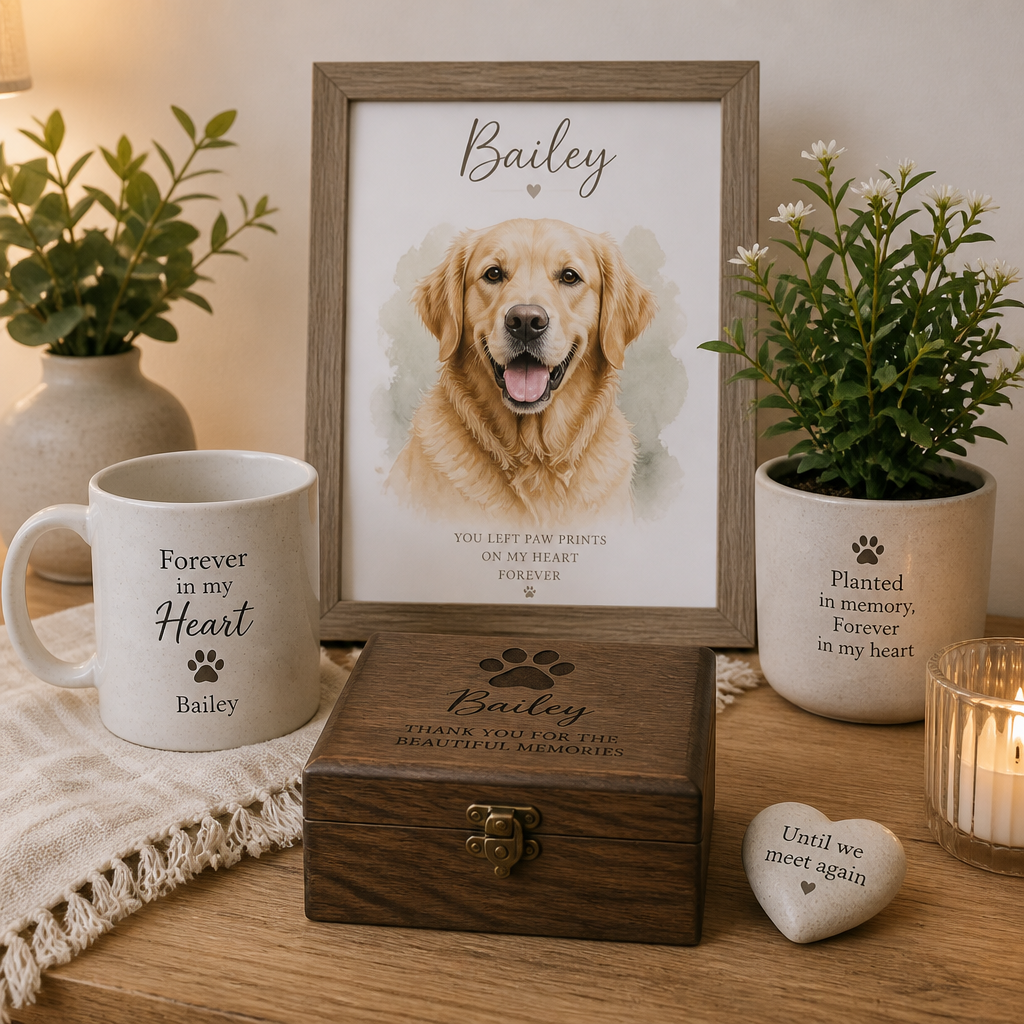
Idea 5: A Memory Box or Keepsake Collection
A memory box is exactly what it sounds like: a dedicated container for the objects that represent your pet. A favorite toy, their collar or tag, a lock of fur, a paw print impression, and printed photos are all candidates. The act of gathering these items shortly after a pet's passing is itself a form of grieving that many owners find grounding.
The box does not need to be displayed permanently. Some people keep it on a shelf; others store it and bring it out on anniversaries. What matters is that the objects inside are intentionally chosen rather than randomly shoved in a drawer where they might be found years later without context. Curating the box is part of the ritual.
Idea 6: Personalized Ceramic Mug or Everyday Keepsake
There is something quietly powerful about using a personalized ceramic mug with your pet's face on it every single morning. It is not dramatic. It is not a ceremony. It is just a daily moment of acknowledgment that says: this animal was part of my life and still is, in the ways I choose to keep them.
The Soul Keep offers custom ceramic mugs alongside a range of other personalized everyday items. The best everyday keepsakes are ones you will actually use, not ones that will sit in a cabinet feeling too precious to touch. A mug, a phone case, a car ornament: these are objects that keep a pet's memory active in your daily rhythm rather than archived in a box.
Car ornaments deserve a specific mention here. Many pet owners spend significant time in their vehicles. A personalized car ornament with a pet's name or image is a form of tribute that travels with you, visible during the commutes and errands that used to feel ordinary but now feel notably quieter.
Idea 7: Write a Letter or Memory Journal
Writing is one of the most direct and least expensive grief tools available, and it works particularly well for pet loss because the relationship was private and personal in ways that are sometimes difficult to explain to others. Two specific approaches stand out above the rest.
Write a Letter From Your Pet's Perspective
This specific technique, writing a letter or story to yourself as if your pet were the author, is one of the most cathartic exercises reported by grieving pet owners. It forces you to inhabit your pet's point of view, which naturally calls up specific memories, inside jokes, daily routines, and moments of connection that pure grief tends to blur. The result is usually a document that makes you both cry and smile, which is exactly where healing lives.
Keep a Dedicated Memory Journal
A memory journal is different from a diary. Rather than recording how you feel day to day, it records specific memories of your pet: what they ate, how they slept, the funny things they did, the ways they communicated with you. Recording these details shortly after a pet's passing is important because specific memories fade faster than general feelings. The journal preserves the texture of the relationship, not just the emotion of the loss.
Idea 8: Donate or Volunteer in Your Pet's Name
Asking friends and family to donate to an animal shelter or rescue organization in lieu of sympathy cards or flowers is a meaningful way to transform private grief into public good. Many shelters accept memorial donations and will send a card to the family acknowledging the tribute. That external acknowledgment, the recognition that the animal's passing mattered enough to prompt generosity, is meaningful for many owners.
Volunteering directly, walking shelter dogs, socializing kittens, or helping with adoption events, is another option for people who process grief through action rather than objects. It keeps you in contact with animals, which most pet owners find comforting rather than painful, and it channels the caregiving instinct that a pet's death leaves without an outlet.
Idea 9: Hold a Small Memorial Gathering
Pet loss is still under-acknowledged in most social circles. Many owners feel they cannot take time off work, cannot ask for support, and cannot hold a formal service the way they would for a human family member. Pushing back against that norm by holding a small, intentional gathering is one of the more courageous pet loss tribute options on this list.
The gathering does not need to be elaborate. Invite the people who actually knew your pet, who house-sat for them, who visited regularly, who understood the relationship. Share specific stories. Look at photos together. Light a candle. The point is to create a shared acknowledgment that the animal existed, mattered, and is missed. That social validation of grief is something many pet owners never receive, and receiving it even once makes a measurable difference.
Comparing Memorial Approaches
Different memorial approaches serve different emotional needs. Some people need something physical and immediate. Others need something that grows over time. And some need something they can wear or carry. The table below compares three of the most common approaches to help you identify which fits your situation best.
|
Memorial Approach |
Best For |
Key Consideration |
|---|---|---|
|
Personalized Keepsake (jewelry, mug, blanket, ornament) |
Owners who want daily, tactile connection with their pet's memory |
Quality and personalization matter enormously. A generic product with just a name added is less comforting than one designed with real specificity around your pet's image or details. |
|
Living Tribute (memorial tree, garden, biodegradable urn) |
Owners who find comfort in natural cycles and long-term growth |
Requires ongoing care. A plant that dies creates secondary grief. Choose a hardy, climate-appropriate species and a location you will visit regularly. |
|
Ritual or Written Memorial (letter, journal, gathering, donation) |
Owners who process grief through expression, action, or community |
These approaches benefit from being done intentionally and relatively soon after the loss, while specific memories are still sharp. They are also the most flexible and cost-effective options available. |
Frequently Asked Questions
How soon after a pet's death should I create a memorial?
There is no correct timeline. Some owners find that creating something immediately, gathering the collar and toys into a box the same week, helps them feel like they are doing something purposeful during an overwhelming time. Others need weeks or months before they can engage with memorialization without it deepening acute grief. Both responses are normal. The only mistake is forcing a timeline that does not match your own emotional state.
What is the most lasting type of pet memorial?
Lasting depends on what you mean. A planted tree can outlive everyone in the household. An engraved ring can be passed to children or grandchildren. A written memory journal can be shared with family long after the pet is gone. In practice, the most lasting memorial is the one that is specific enough to feel irreplaceable, meaning it could not belong to any other pet. Personalization is what makes something last in emotional terms, not the material it is made from.
Is it appropriate to hold a formal memorial service for a pet?
Completely appropriate, and more common than many people realize. Pet loss is genuine grief, and the social rituals that help with human bereavement, shared stories, acknowledgment from loved ones, a moment of deliberate goodbye, help with pet bereavement too. A small gathering of people who actually knew the animal is almost always more healing than handling the loss in total private silence.
What should I do with my pet's ashes?
The options are wide. Cremation jewelry allows you to keep a small amount of ashes in a wearable piece. Biodegradable urns let ashes become part of a growing tree. Some owners scatter ashes in a place that was meaningful to the pet, such as a favorite park or hiking trail. Others keep ashes in a decorative urn at home, sometimes alongside photos and other mementos. None of these choices is more correct than another. The right option is the one that feels right to you specifically.
How do I explain pet loss to children when creating a memorial?
Involving children directly in the memorial process tends to work far better than shielding them from it. Let children choose one item to put in a memory box, help plant a memorial flower, or draw a picture of the pet for a scrapbook. These acts give children a concrete way to process loss and teach them that grief is something you honor actively rather than something to be hidden. The memorial becomes a shared family ritual rather than an adult-only experience.
How do I choose the right personalized memorial product?
Start with the context in which you most often think about your pet. If it is every morning with a cup of coffee, a custom mug is right. If it is every time you leave the house, a car ornament or piece of jewelry makes sense. If it is at home in the evening, a memorial blanket or pillow will serve you best. The best product is the one that will actually be used and seen regularly, not the one that seems most impressive on a product page. Sites like The Soul Keep offer a range of options precisely because different owners have different daily rhythms.
We would love to hear from you: what has been your most meaningful way of honoring a pet's memory, and is there something that surprised you about what actually helped?